
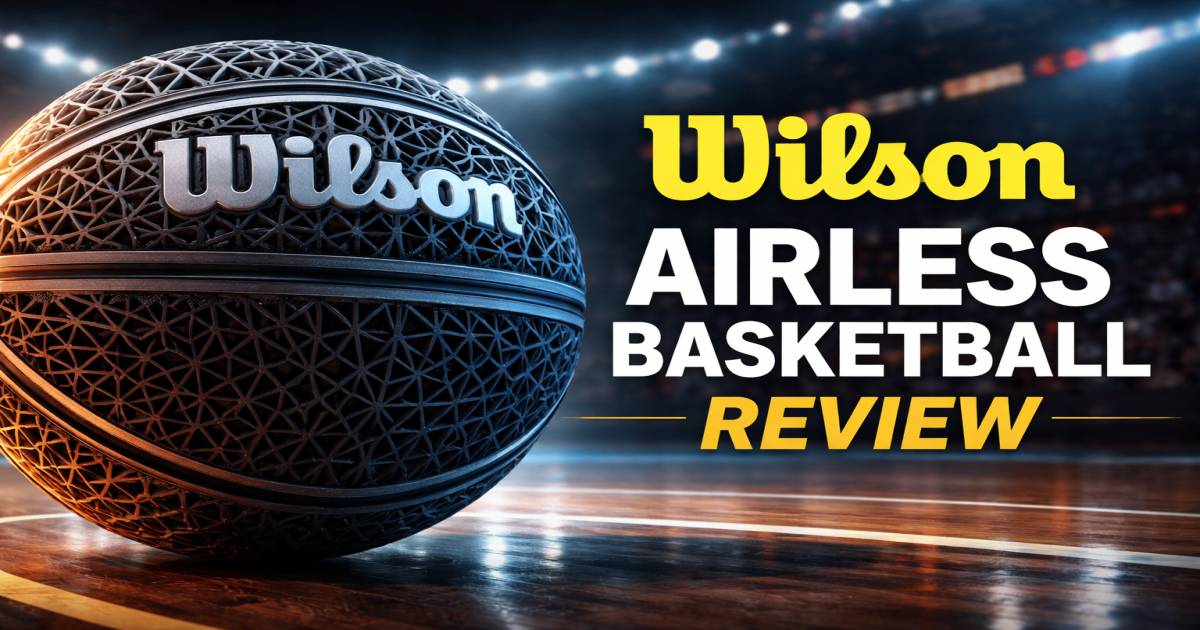
Wilson Airless Basketball Review: Technology, Feel, Durability & Real-World Use
Quick Verdict (TL;DR): The Wilson Airless Gen1 is a genuine technical milestone, a 3D-printed, never-inflate basketball engineered to match regulation weight, size, and bounce, but it’s currently a high-priced, limited-run collectible more than a mass-market replacement for pumped balls. If you care about innovation, design, or collecting rare sports tech, it’s worth following; if you’re a budget player or need a workhorse outdoor ball, traditional or NeverFlat options remain more practical.
What is The Wilson Airless Basketball?
The Wilson Airless Gen1 is the first commercially available basketball made with 3D printing and designed to be used without air. Instead of a bladder filled with air, it uses a purpose-designed lattice shell printed in a flexible polymer so the ball deforms and rebounds in a controlled way, attempting to mimic the feel and bounce of a regulation leather or composite ball. Wilson first showed an airless prototype during the NBA All-Star dunk contest and later announced a limited retail release (Gen1).
Why Wilson built it: Wilson’s stated goals were to prove additive manufacturing can produce a playable ball that’s “never flat,” reduce waste from replaced balls, and open a design runway for new forms of customization and limited collectors’ editions. The Gen1 is presented as both playable and collectible. Wilson sold initial, limited drops and bundled them as premium items.
Quick Timeline (Prototype → Gen1 Retail)
- Feb 2023: Airless prototype unveiled at NBA All-Star Slam Dunk Contest (prototype play demos).
- 2023–2024: Wilson iterated the design with partners (EOS, General Lattice, DyeMansion, SNL Creative) to improve lattice performance and manufacturability.
- Feb 2024: Wilson announced the Gen1 retail launch and limited availability, citing a retail price of roughly $2,500 per ball for initial drops.
How The Airless Tech Works (Materials & Manufacturing)
The Airless Gen1 uses additive manufacturing (selective laser sintering / SLS-style methods) to print a continuous lattice shell in a flexible polymer. Computational design tools create a lattice geometry that deforms under load and springs back, approximating the rebound characteristics of an inflated bladder. Partners named in the launch: EOS, General Lattice, and DyeMansion handled printing, design optimization, and finishing so each ball gets a smooth outer surface and consistent performance.
Key engineering notes readers care about:
- Lattice geometry = engineered compliance. The lattice’s cell shape, wall thickness, and node layout determine how much energy is stored and released on impact (i.e., bounce). Wilson tuned those variables to match regulation rebound as closely as possible.
- Materials matter. The printed polymers behave differently than bladder-air systems; they can age from UV or abrasion differently and may have different temperature sensitivity. Wilson’s production finishing (DyeMansion treatments, vapor smoothing) is designed to improve surface feel.
Performance: Feel, Bounce, and Handling
This is the question most readers search for: Does it play like a regular ball? Wilson and partners report that Gen1 nearly meets performance specs for weight, size, and rebound. Independent hands-on impressions (journalists and early reviewers) say it’s impressively close on bounce and noticeably different in texture and sound. Some testers described the dribble as “near-silent” compared to a pumped leather/composite ball.
Practical performance observations to include in your article or tests:
- Bounce/Rebound: Wilson claims near-regulation rebound; independent reviewers report comparable bounce in controlled tests, though exact rebound percentages vary by test method. If you publish, include a reproducible test (drop from X cm, average over N trials).
- Grip and Handling: A tacky feel is built into the printed outer surface, yet it remains distinct from the grip characteristics of leather or advanced composite materials.
- Sound/Noise: Multiple early impressions note a quieter bounce, which could be an advantage in indoor, multi-use spaces.
Transparency: I have not personally tested a Gen1 sample; this review synthesizes primary materials from Wilson and EOS plus independent press reviews. If you run your own tests, describe your surface, drop height, and sample size so readers can compare.
Durability & Maintenance — The Big Tradeoffs
Pros
- No punctures, no leaks, no needles: The ball cannot go flat, eliminating a common maintenance pain point. If you prize “set and forget,” that’s a major plus.
Potential Cons
- Abrasion & outdoor courts: The printed polymer lattice is likely more vulnerable to abrasive outdoor asphalt than rubber/composite covers engineered for outdoor play. Many reviewers advise caution if you plan heavy outdoor use. Long-term abrasion data is not yet widely available.
- UV/heat aging and temperature sensitivity: Extended heat and sun exposure can shorten polymer durability. Even with Wilson’s finishing process, users should anticipate a distinct aging pattern compared to leather or composite balls.
- Repairability and warranty: A ruptured bladder can occasionally be fixed, but damage to a printed lattice typically means the ball must be replaced instead of repaired.
Bottom line on durability: The “never flat” promise solves inflation failures but swaps in new questions about abrasion and polymer aging. For collectors or careful indoor use, that tradeoff is reasonable; for playground or outdoor heavy use, conventional outdoor balls still look more rugged and affordable.
Price, Availability & Buying Guidance
Wilson marketed the Gen1 as a limited-edition, high-end launch. Initial drops were limited in number and carried a retail price of around $2,500. That positioning makes Gen1 a premium collectible/early-adopter purchase rather than a mainstream consumer basketball. Expect limited availability, reseller markups, and occasional restocks or future generations with different pricing.
Where to buy: The official Wilson store (sign-ups for drops) is the primary channel. Secondary marketplaces (StockX, eBay) may show resales with substantial premiums. If you plan to buy: buy from Wilson when available, verify serial/numbering, and keep warranty and authenticity docs.
How it Compares (Quick Table)
| Feature | Wilson Airless Gen1 | Traditional Pumped Ball | Spalding NeverFlat |
| Inflation needed | No | Yes | Yes (but extended) |
| Bounce consistency | Engineered lattice, near regulation | Dependent on pressure | Extended inflation via NitroFlate |
| Durability outdoors | Unknown, potential abrasion risk | Varies (outdoor balls rugged) | Indoor/outdoor with year-long inflation claim |
| Price (retail) | ~$2,500 (limited) | $15–$200 | $30–$60 |
| Best for | Collectors, tech lovers, indoor demos | Everyday play, all budgets | Low-maintenance use, practice |
Sources: Wilson product & PR; Spalding product pages and retail listings.
Who Should Buy a Wilson Airless Gen1?
- Tech collectors and early adopters who value rarity and design.
- Coaches or facilities that want a consistent, low-maintenance ball for indoor controlled environments (budget permitting).
- Brands or creatives interested in one-off colorways and customization possibilities.
Who should skip: Budget players, heavy outdoor players, or anyone who wants a rugged, low-cost ball for everyday street use. For practical play, Spalding’s NeverFlat or a quality outdoor composite ball is a smarter buy.
Real-World Use Cases & User Feedback
Early adopters and journalists report that the Gen1 draws attention in person; its aesthetics alone make it a social-media moment. Early playtests indicate it can be used in real practice scenarios, but most independent reviewers frame it as a novelty/collector item because of limited runs and the premium price. Social posts and YouTube unboxings show positive impressions on bounce and “cool factor,” but also note the high price and limited practical adoption so far.
Final Verdict & Recommendation
The Wilson Airless Gen1 is an impressive engineering demonstration and the first commercially sold 3D-printed basketball; it’s likely to be remembered as a cultural and design milestone. For most players, the practical limitations (price, limited stock, outdoor durability uncertainty) mean the Gen1 is a wait/observe or buy if you’re a collector decision. If Wilson continues to iterate and reduces cost in future generations, airless tech could become a mainstream option, but for now, treat Gen1 as innovation you watch, not yet the everyday replacement.
FAQs About Wilson Airless Basketball
Q1: What is the Wilson Airless Basketball?
A: The Airless Gen1 is a 3D-printed basketball with a flexible lattice shell designed to eliminate inflation needs while approximating the bounce of a regulation ball.
Q2: How much does it cost?
A: Initial retail drops were priced around $2,500, and early releases were limited in number. Expect resale premiums.
Q3: Is it good for outdoor courts?
A: It’s primarily presented as an indoor/collector/playable ball; heavy outdoor abrasion on rough asphalt may wear the polymer surface faster than rubber/outdoor composites.
Q4: How does it compare to Spalding NeverFlat?
A: NeverFlat keeps air longer inside a bladder (extended inflation tech) and is far cheaper; Wilson’s Airless removes the bladder altogether via a printed lattice; different engineering approaches with various tradeoffs.