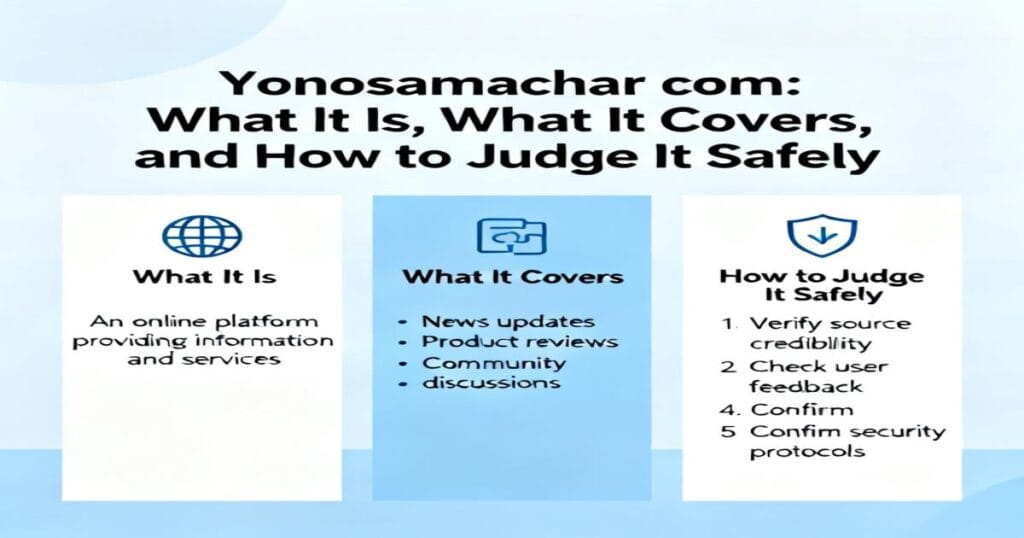
Yonosamachar com: What It Is, What It Covers, and How to Judge It Safely
Searches for yonosamachar com usually point people toward a simple question: what kind of site is this, and should I trust it? Based on publicly visible search snippets, the site appears to be a blog-style content platform with broad topic coverage, including business, education, entertainment, fashion, finance, lifestyle, technology, travel, general news, and automotive topics. Public snippets also show individual posts on subjects such as small business loans, student loan apps, and market-platform updates, which suggests the site is built around short informational articles rather than long investigative reporting.
That matters because not every website serves the same purpose. Some sites are newsrooms, some are niche blogs, and some are content hubs designed to answer everyday questions quickly. In an online world where anyone can publish information, readers need a simple way to separate useful content from content that only looks polished. Trusted guidance from Google, the FTC, Harvard, and the News Literacy Project all point to the same idea: good information should be people-first, transparent, and checked against other reliable sources when the topic is important.
What Is Yonosamachar com?
Yonosamachar com appears to be a content website with a wide subject mix. Public search results show a homepage that lists multiple categories, including Business, Education, Entertainment, Fashion, Finance, General, Health, Lifestyle, Technology, and Travel. That category structure is a strong sign of a general-interest blog or article site rather than a narrow specialist publication.
The search snippets also show post titles that sound like practical explainers and how-to guides. Examples include articles on comparing lenders for small business loans, student loan apps, MT5 updates, and money withdrawal charges. Those examples suggest the site aims to attract readers who want quick, plain-language explanations on money, business, and digital tools.
A public author archive is also visible in search results, which indicates that the site publishes under identifiable bylines or author pages. That is useful because author pages can help readers track who wrote what, even if the site itself is not a major newsroom. A visible author archive does not automatically prove expertise, but it does give readers something to inspect.
What the Public Pages Suggest About the Site
The most useful thing about the publicly visible pages is that they reveal the site’s structure. Instead of a single-topic publication, Yonosamachar com seems to be organized like a multi-category blog with archive pages and pagination. That pattern is common among content sites that publish frequent short articles across different topics.
One public page also shows the phrase “The motive is to make your business,” which reads like a tagline or theme text rather than a formal newsroom mission statement. That does not tell us everything about the editorial process, but it does reinforce the impression that the site is built to publish practical, business-adjacent content for readers rather than to operate like a traditional hard-news outlet.
Another notable detail is that public snippets show articles dated across 2025 and 2026, which suggests the site has been active recently rather than being an abandoned domain. Recent activity can matter because an inactive site may leave readers with outdated information, especially on finance or technology topics.
What Topics Does Yonosamachar com Cover?
Business and finance
The clearest theme visible in the public results is finance and business. Search snippets show posts about comparing small business lenders, student loan apps, and withdrawal charges for a mobile-money service. That is a strong hint that the site wants to attract readers looking for practical money guidance, financial management ideas, and business-related explainers.
For U.S. readers, that topic mix matters because finance content can be useful but also risky. A clean headline does not guarantee accurate advice. The FTC recommends checking a variety of sources, while Google’s helpful-content guidance emphasizes content created for people rather than search manipulation. In plain terms, financial articles should be readable, but they should also be verified.
Education and practical guidance
Education-related content also appears in the category list, which suggests the site may publish practical guides and informational explainers. On websites like this, education often overlaps with career advice, student finance, online learning, and digital skills. The site’s visible structure supports that interpretation, even if the snippets do not reveal every individual article.
This kind of content can be valuable when it is written clearly and updated often. It is especially useful for readers who want fast answers without reading long reports. Google’s guidance on helpful content emphasizes clarity, reliability, and usefulness to people first, which is a good standard for any educational or how-to page.
Technology and digital tools
Technology is another visible category. That tells us the site does not focus only on everyday lifestyle topics. A tech category often includes software updates, app explainers, device tips, and platform guides, all of which can attract search traffic from people trying to solve a specific problem fast.
This matters because technology content changes quickly. A guide that is useful today may be outdated in a few months if the product, interface, or policy changes. That is why readers should look for signs of freshness, such as publication dates, recent updates, and consistent wording across the article. The FTC and Harvard both emphasize that web sources should be checked for credibility, because anyone can publish online.
Lifestyle, entertainment, and general-interest articles
The category list also includes entertainment, fashion, lifestyle, general, and travel. That mix makes the site feel broader and more mainstream. It looks designed for everyday browsing, not just for specialists in finance or business.
Sites with this kind of variety often do well because they can reach readers with many different interests. A general-interest blog can bring together money tips, trend pieces, and practical explainers in one place. The trade-off is that broad coverage sometimes comes with uneven depth, so readers should judge each article on its own merits. That is exactly the kind of habit promoted by news literacy educators, who stress accuracy, transparency, independence, and fairness.
Why People Search for Yonosamachar com

A lot of people search for a site like this because they want a fast answer to a specific question. A blog-style site with short posts can feel easier than a large news homepage packed with banners, sidebars, and unrelated stories. Search snippets suggest that Yonosamachar com is built for that kind of quick reading experience.
Another reason is topic convenience. When a site covers finance, technology, and everyday lifestyle material under one roof, readers can move from one question to the next without leaving the site. That convenience can be a real advantage for casual users who want simple explanations on current topics.
A third reason is search visibility. Sites with many category pages and article archives often show up in search engines for long-tail queries like small business loans, loan apps, or technology updates. Google’s guidance makes clear that search systems aim to reward helpful, people-first content, so sites that answer narrow questions clearly can get visibility even without being famous brands.
Is Yonosamachar com Trustworthy?
The honest answer is that the public snippets show enough to describe the site, but not enough to fully verify every editorial practice. We can see categories, post titles, archive pages, and an author archive, but snippets alone do not prove a site’s fact-checking process, sourcing standards, or review policy. That means readers should treat it as a starting point, not the final word, especially on money, health, or legal topics.
That approach lines up with standard source-evaluation advice. Harvard’s guide notes that web sources can be created by anyone, which makes them inherently riskier than many other source types. The FTC also recommends comparing multiple sources and watching for signs that something is off. The News Literacy Project adds that credibility depends on accuracy, transparency, independence, and fairness.
A practical reading of the site is this: Yonosamachar com looks like a general content site with some practical information value, but not like a high-authority reference source on its own. That is not a criticism; it is simply the right way to classify it based on what is publicly visible.
How to Judge Any Article on the Site
Check the topic against the stakes
Not every article needs the same level of scrutiny. A light lifestyle post is not the same as a finance article about loans, fees, or consumer decisions. Google’s people-first guidance and the FTC’s advice both support a simple idea: the more important the decision, the more verification you should do.
For example, if an article is about business financing, student loans, or app-based financial tools, compare the claims with another trusted source before acting on them. That is especially important because financial decisions can affect credit, cash flow, and long-term costs.
Look for clear authorship
Public search snippets show an author archive, which is a positive sign. But readers should also look for clear bylines, author bios, and other evidence that a real person or editorial process stands behind the article. Transparency is one of the core credibility signals highlighted by news literacy educators.
Watch for freshness
Older content can still be useful, but the date matters. A page from last year may be fine for general background, while a page on rates, apps, or tools may need a fresh update. The FTC specifically recommends paying attention to recency when evaluating information, because freshness can change what is true or useful.
Compare with other sources
This is one of the simplest and best habits a reader can build. If one site says something important, see whether another reputable source says the same thing. That is the easiest way to protect yourself from weak sourcing, oversimplified advice, or outdated claims.
Pros and Cons of Yonosamachar com
Pros
It appears easy to browse, with clear topic categories and a simple archive structure.
It covers several practical topics, including business, finance, and technology, which gives readers more than one reason to visit.
It seems built for quick reading, which is useful for busy users who want a fast overview rather than a long report.
Cons
The public snippets do not show enough evidence to treat it as a top-tier authoritative source on sensitive subjects.
Some visible topic areas, especially finance-related ones, should always be verified against stronger sources before making decisions.
Because it is broad in scope, article quality may vary from one category to another. That is normal for many multi-topic blogs, but it means readers need to stay selective.
Why the Site Fits Search-Driven Reading
Modern readers often arrive at a page through a search query rather than through a homepage. That is why simple titles, short intros, and clear categories matter so much. Yonosamachar com’s visible structure suggests it is built with this behavior in mind.
That model can work well when the content is genuinely useful. Google’s helpful-content guidance is clear that systems are designed to reward material made for people, not content created mainly to game rankings. In other words, readers reward clarity, usefulness, and relevance, and search engines increasingly try to do the same.
For website owners and content creators, that is the bigger lesson behind a site like this. It is not enough to publish many pages. The pages have to answer real questions well, use plain language, and demonstrate enough trust signals that people feel comfortable reading them.
Practical Takeaway for U.S. Readers
If you are in the U.S. and you find Yonosamachar com through a search, use it like a helpful first stop rather than a final authority. That is especially true for personal finance, business lending, app-based money tools, or any topic where a mistake could cost money.
For general reading, the site’s broad categories and simple article style may make it easy to browse. For anything important, cross-check the claims, look at the date, and see whether the article explains where its information came from. Those habits are supported by the FTC, Harvard, and the News Literacy Project.
Conclusion
Yonosamachar com appears to be a broad, blog-style content site with categories that span business, education, entertainment, fashion, finance, lifestyle, technology, travel, general interest, and more. Public snippets show that it publishes practical explainers and short-form informational posts, especially on money and business-related topics.
The safest way to use it is the same way you should use many online content sites: read it for quick context, then verify important claims with more than one reliable source. That habit protects you from weak sourcing and helps you make better decisions. Good information is not just easy to read; it is also clear, transparent, and checked.
If you have read Yonosamachar com before, pay attention to the article topics, the dates, and whether the claims are supported. A little caution goes a long way online.
FAQ
Q1. What is Yonosamachar com?
It appears to be a general-interest content site with categories such as business, finance, technology, lifestyle, and more.
Q2. Is Yonosamachar com a news website?
Public search snippets suggest it is more of a blog-style information site than a traditional newsroom.
Q3. What topics does it cover?
Visible categories and snippets show business, finance, education, entertainment, lifestyle, travel, and technology topics.
Q4. Is it safe to trust financial advice from the site?
Treat financial articles as a starting point, not final advice, and verify important claims with other trusted sources.
Q5. Does the site show authorship?
Yes, public search results show an author archive, which is a useful transparency signal.
Q6. Why do people search for it?
Usually, to get quick, simple explanations on practical topics without reading a long report.
Q7. What is the best way to use it?
Read it for quick context, check the date, and compare important claims with other reliable sources.
Q8. Is Yonosamachar com useful?
It can be useful for broad, easy-to-read overviews, especially when you want a quick look at a topic.