
Retailers Entering Fuel Business Success Strategies
Retailers entering the fuel business create convenient one stop shopping experiences by adding gas stations to their locations. This trend boosts customer traffic and revenue streams for USA based chains and global players alike.
Retailers entering fuel business respond to steady demand for fuel alongside everyday shopping needs. High traffic store locations make ideal spots for pumps, drawing drivers who then buy groceries or goods inside. Fuel business management integrates seamlessly with retail operations for efficiency.
Why Retailers Diversify into Fuel Retail
Retailers diversify into fuel retail to combat slim margins in traditional sales categories. Fuel serves as a loss leader, attracting customers who spend on higher profit items like prepared foods and beverages.
Evolving consumer habits favor fewer trips, combining errands with refueling. List of retailers entering fuel business expands as chains seek diversified income amid online shopping growth.
Stable fuel demand provides recession resistance compared to discretionary retail spending.
Proven Success Cases: USA and Global Leaders
USA Leaders
- Walmart expanded to over 400 stations, offering open access and loyalty discounts to drive store visits.
- Costco operates 700 plus stations, where fuel accounts for significant member value through low prices.
- Dollar General grew from pilots to dozens of sites, targeting rural areas with combined convenience.
- Sams Club enhances stations with extended hours and larger capacities.
Global Leaders
- Tesco in the UK runs 500 plus stations linked directly to supermarkets.
- Asda UK manages over 300 fuel sites with grocery integration.
- Coles in Australia oversees nearly 700 petrol locations.
- Auchan in Europe adds fuel across thousands of hypermarkets.
| Retailer | Locations | Key Success Factor |
| Walmart (USA) | 400+ | Open access, loyalty discounts |
| Costco (USA) | 700+ | Member only low prices |
| Tesco (UK) | 500+ | Grocery fuel integration |
| Dollar General | 40+ | Rural convenience |
These examples highlight effective fuel business management through prime locations and customer perks.
Strategic Benefits of Fuel Diversification
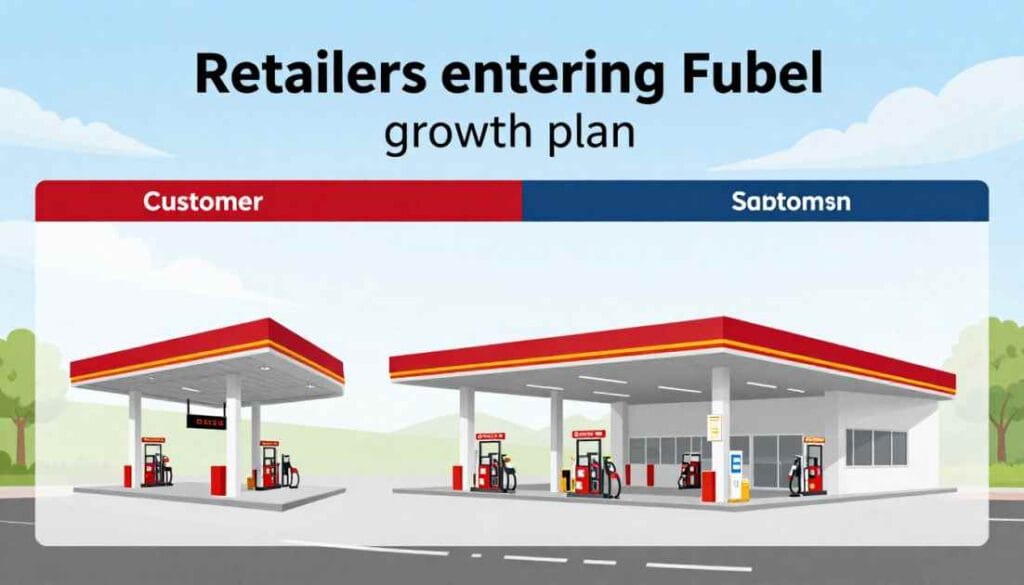
Fuel diversification increases foot traffic by up to 10 percent, as drivers convert to in store shoppers. This lifts overall sales, especially convenience items with 30 to 50 percent margins.
Retailers gain revenue stability by blending low margin fuel with high margin goods. Customer data from fuel transactions enables personalized marketing and loyalty programs.
Supply chain control reduces costs, while mobile fuel business options extend services to fleets.
Critical Challenges in Fuel Retail Entry
Entry demands high upfront costs for tanks, pumps, and compliance, often millions per site. Volatile fuel prices create inventory risks and squeeze margins.
Intense competition from established oil brands pressures pricing power. Supply disruptions and labor shortages complicate daily operations.
Long term, electric vehicles erode traditional fuel volume, requiring adaptation.
- Price fluctuations impact profitability.
- Regulatory compliance adds ongoing expenses.
- Skilled technicians prove hard to hire.
Essential Steps to Launch Fuel Operations
Planning Phase
- Assess site viability based on traffic volume and zoning laws.
- Partner with fuel suppliers or franchises for branding and supply.
Build Phase
- Install compliant underground storage tanks and pumps.
- Integrate convenience features like EV chargers and stores.
Launch Phase
- Secure all permits, insurance, and safety certifications.
- Train staff in fuel business management and customer service.
- Promote with discounts and local advertising.
Expect initial investments of 2 to 5 million dollars, focusing on high volume corridors.
Enhancing Convenience for Revenue Growth
Convenience features turn fuel stops into longer visits. Mobile fuel business services deliver to commercial fleets, expanding beyond retail pumps.
Combine with car washes, quick service food, and package pickup points. Loyalty apps offer tiered fuel discounts tied to store spending.
Self service kiosks and contactless payments reduce wait times, boosting satisfaction.
Navigating USA and Global Fuel Regulations
In the USA, EPA rules mandate reformulated gasoline in urban areas to cut emissions. Retailers must prevent fuel contamination and conduct tank inspections.
FTC requires clear fuel octane ratings at pumps. States oversee underground storage with leak prevention standards.
Globally, regulations vary: EU emphasizes low sulfur fuels, while markets like Australia focus on consumer protections.
- Register as a fuel retailer with federal agencies.
- Perform annual compliance audits.
- Implement vapor recovery systems seasonally.
Smart Financial Planning and Funding
Aim for 12 percent gross fuel margins, netting 5 percent after expenses. Use historical sales data to forecast volumes and seasonal peaks.
Secure bulk supply contracts and maintain buffer inventory. Diversify funding through bank loans, investors, or retail cash flow.
Monitor cash flow weekly, targeting break even within four to six months.
| Metric | Target | Benchmark |
| Fuel Margin | 12% gross | 10 15% industry avg |
| Break Even | 4 months | Location dependent |
| Year 1 EBITDA | $1 million | Scaled operations |
Preparing for EV and Energy Transitions
Proactively install EV chargers to capture future traffic; many retailers now lead with networks at stores. Longer charging times increase in store spending opportunities.
Explore biofuels, hydrogen stations, and solar powered canopies. Hybrid models blend fuel with alternative energy.
Projections indicate 20 percent of stations need EV infrastructure by 2030.
Scaling Operations and Measuring Success
Scale by replicating proven sites near distribution hubs. Adopt software for real time inventory, pricing, and demand forecasting.
Track these KPIs:
- Monthly fuel gallons sold.
- Non fuel sales percentage, targeting 25 percent or higher.
- Customer retention via loyalty sign ups.
- Peak hour pump utilization at 80 percent.
- Net Promoter Score exceeding 70.
Integrate point of sale systems for daily insights.
| KPI | Formula | Goal |
| Conversion Rate | (Transactions / Visitors) x 100 | 65%+ |
| Fuel Margin % | (Sell Cost)/Sell x 100 | 12% |
| Annual Footfall Growth | YoY visitors increase | 10% |
Key Takeaways
- Prioritize high traffic sites and full regulatory compliance.
- Bundle fuel with high margin convenience offerings.
- Monitor KPIs rigorously for optimization.
- Integrate EV readiness from day one.
- Leverage loyalty programs for cross selling.
Final Thoughts
Retailers entering fuel business unlock growth by merging retail convenience with essential fueling services. USA pioneers demonstrate scalable paths adaptable worldwide.
Strong fuel business management navigates challenges like regulations and energy shifts for sustained profitability.
FAQs
What defines mobile fuel business?
Mobile fuel business provides on demand delivery to fleets and sites, ideal for retailers serving commercial clients.
Provide list of retailers entering fuel business.
USA examples include Walmart, Costco, and Dollar General. Global players feature Tesco and Coles.
Why pursue fuel retail diversification now?
It drives traffic and revenue stability in a shifting retail landscape.
How do EVs affect fuel retail?
Retailers counter by adding chargers, turning stations into multi energy hubs.
What are typical startup costs?
Expect 2 to 5 million dollars for infrastructure, permits, and initial inventory.
One Comment