
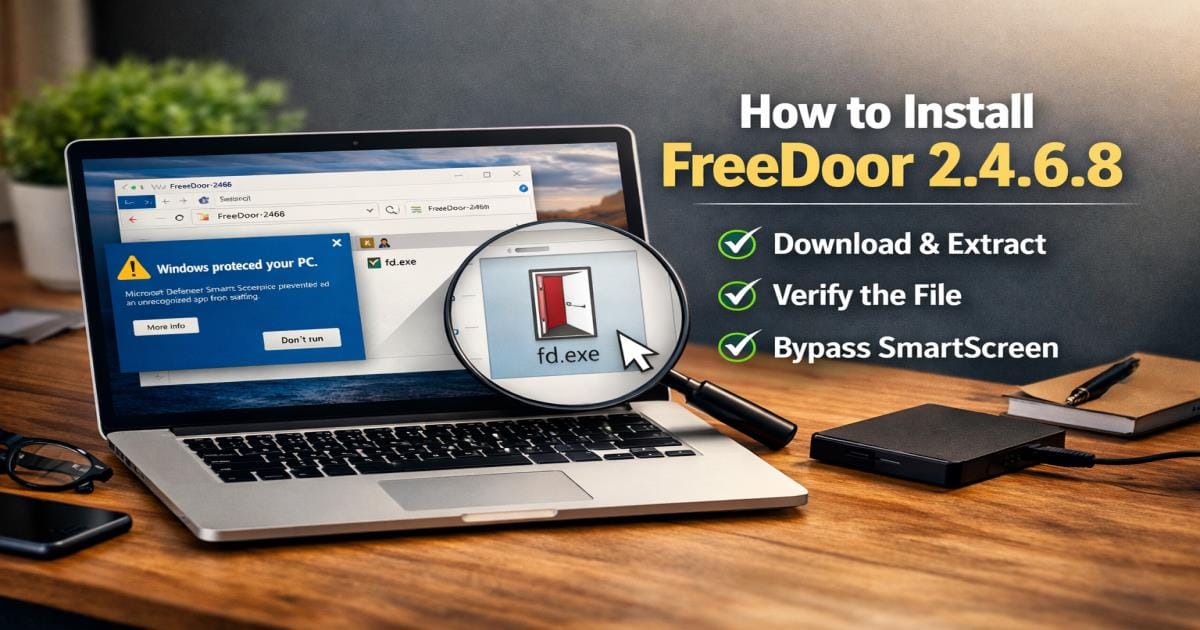
How to Install FreeDoor2.4.6.8 on Windows Safely Today
If you are searching for how to install freedoor2.4.6.8, the most important thing to know is this: the safest installation process starts before you ever double-click the file. For any downloaded Windows program, Microsoft recommends getting software only from trusted sources and letting built-in security checks scan the file during download. Microsoft Defender SmartScreen can also warn you about suspicious downloads and unrecognized apps.
Publicly available pages describing FreeDoor2.4.6.8 are limited, and the naming can be inconsistent. Some guides describe it as a lightweight, portable Windows proxy tool that is downloaded, extracted, and then launched from its main executable. Because of that, the best approach is to treat it like a downloadable Windows utility package: verify it first, install or extract it carefully, then test it in a controlled way.
This article walks you through a practical, safety-first process that works well for the most downloaded Windows tools and fits the public descriptions of FreeDoor2.4.6.8. It also explains what to do when Windows raises a warning, how to troubleshoot common problems, and how to keep your device protected while using any network-related software.
What FreeDoor2.4.6.8 appears to be
Based on the public descriptions that are easy to find, FreeDoor2.4.6.8 is commonly presented as a small Windows proxy-style utility associated with Dynamic Internet Technology’s DynaWeb ecosystem. DynaWeb itself is described by the company as a web-based anti-censorship portal, and the official DynaWeb pages say no software is needed for the portal experience. At the same time, some third-party guides describe FreeDoor2.4.6.8 as a portable Windows program that runs after extraction. Those two descriptions are not identical, so it is smart to treat your file as a separate build and verify it before use.
That matters because installation advice depends on the package type. A standard Windows installer behaves one way. A portable ZIP package behaves differently. If your copy of FreeDoor 2.4.6.8 opens as a ZIP archive or contains a standalone executable, then the process will likely look more like extraction and first launch than a classic next, next, finish installer.
Before you install FreeDoor2.4.6.8
Before you touch the file, check three things: the source, the file type, and your Windows security warnings. Microsoft advises downloading and installing programs only from trusted publishers and retail websites, and it notes that Windows Defender and SmartScreen can scan downloads or warn you about potentially unsafe files.
The safest routine is simple. Save the file, scan it, inspect it, and only then open it. That one habit cuts down a lot of risk, especially with tools that are shared in ZIP form or come as an unfamiliar executable. SmartScreen checks downloads against reported malicious sites and suspicious programs, while Windows Security also provides protection for unsafe apps, files, websites, and downloads.
If your version of FreeDoor2.4.6.8 is a portable build, it may not add itself to the installed apps list the way ordinary software does. That can be convenient, but it also means you should be extra careful about keeping the original archive, the extracted folder, and any security prompts you see during the first launch.
How to install FreeDoor2.4.6.8 step by step
Step 1: Download the file carefully
Start by saving the file to a known location, such as Downloads or Desktop. Microsoft’s general guidance for online software says to use the browser download link, save the file, and let your antivirus scan it during the download process.
For a program like FreeDoor2.4.6.8, it is best to keep the archive in one place and avoid renaming it until after you have confirmed what it contains. If the download comes as a ZIP archive, that is often a sign you are dealing with a portable package rather than a traditional installer. Some public guides describe FreeDoor2.4.6.8 in exactly that way.
Step 2: Scan the download before opening it
Right-click the file and run a security scan with Microsoft Defender or your installed antivirus. Microsoft says Defender and SmartScreen are designed to help identify suspicious or unrecognized downloads, and Windows can warn you when a file is not widely trusted.
This step matters even when a file seems small and simple. Small files can still contain unwanted bundles, and a file that looks like a normal utility can still be mislabeled or altered. A quick scan is one of the easiest ways to avoid trouble before you ever run the program.
Step 3: Extract the archive if it is a ZIP file
If the download is compressed, use Windows’ built-in extraction tool or a trusted unzip program to unpack it into a fresh folder. Public guides on FreeDoor2.4.6.8 describe the next steps after extraction as opening the folder and launching the main executable file.
A clean folder keeps things organized and makes troubleshooting much easier. For example, you can create a folder named something like FreeDoor-2468 and extract everything there. That way, you always know where the program files are, and you can remove them later without hunting through multiple directories.
Step 4: Find the main executable
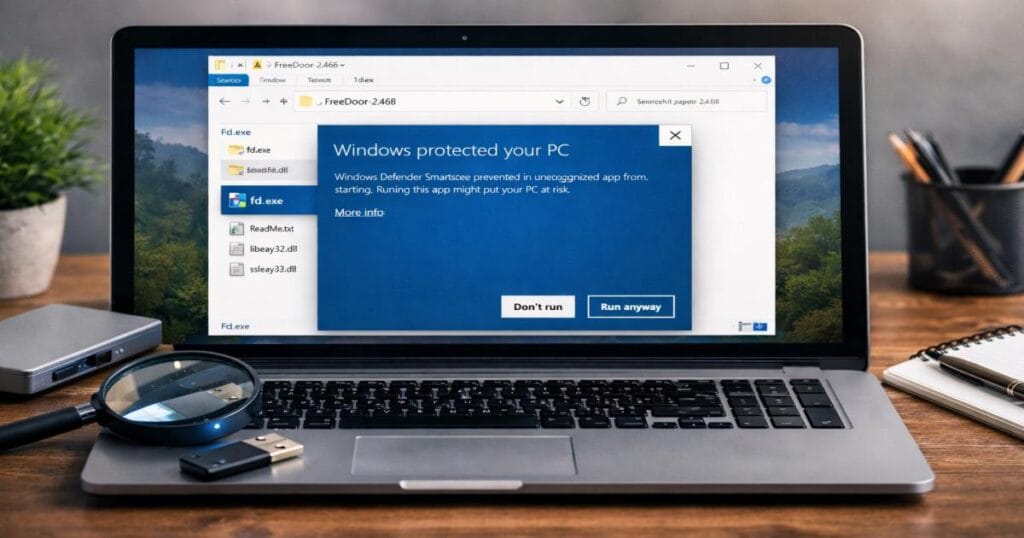
After extraction, look for the primary .exe file. One public guide for this topic says the main file is often named fd.exe, though file names may vary by build. The important part is to identify the file that actually starts the app, rather than random text files or helper folders.
If you see more than one executable and you are not sure which one is correct, pause and inspect the folder first. The safest choice is usually the file that matches the product name and sits at the top level of the extracted folder. Never run a mystery executable just because it is there.
Step 5: Launch the program
Double-click the main executable and wait a few seconds. Public guides describing FreeDoor2.4.6.8 say the tool starts without a long setup wizard and may connect automatically after opening. That makes it feel more like a portable utility than a full system installation.
If Windows asks for permission, read the prompt before clicking anything. A normal security prompt does not automatically mean the file is bad, but it does mean Windows wants your confirmation before making changes. Keep your antivirus running, and do not override warnings unless you are sure the file is the one you intended to use. Microsoft specifically notes that SmartScreen warns about unrecognized apps and suspicious downloads.
Step 6: Handle SmartScreen or security warnings
If SmartScreen appears, check the warning carefully. Microsoft says SmartScreen checks downloads against lists of known bad software and can also warn when a file is not popular or well recognized. That makes it useful for catching risky or unusual downloads.
If you trust the file and you have already scanned it, the warning may still appear simply because the app is unfamiliar. That is common with smaller utility programs. Even then, the safest path is to confirm the source, confirm the file name, and confirm the folder contents before continuing.
Step 7: Confirm that the app is working
Once the app opens, test it gently. Open a browser and try a normal webpage first. If the program has a status indicator, wait for it to settle before assuming it failed. Public guides describing FreeDoor2.4.6.8 say the connection may take a short time to initialize after launch.
It is also a good idea to check whether the app behaves as expected on a stable network connection. Microsoft’s installation guidance emphasizes that downloads and software from the internet should be treated with caution, and that antivirus tools often scan files during or after download.
If your copy includes a setup wizard instead of a ZIP file
Not every build behaves the same way. If your file opens with a setup wizard instead of extracting like a portable app, follow the standard Windows install flow: open the installer, review the prompts, accept the permission request, choose the install location if asked, and finish the wizard. Microsoft’s guidance for apps downloaded from the internet is still the right baseline here.
The main thing is not to rush. Read each screen, make sure the product name matches what you downloaded, and avoid checking extra boxes for unrelated offers or add-ons. That advice is especially useful for security-related software and privacy-focused network tools, where the wrong add-on can change the program’s behavior.
Common problems and easy fixes
1) The file will not open
If the executable does nothing, the most common causes are a blocked file, an incomplete extraction, or a damaged download. Re-download the archive, scan it again, and make sure you extract every file into the same folder before trying again. Microsoft’s download guidance and SmartScreen documentation both support this cautious approach.
2) Windows says the app is unrecognized
That usually means the file is not widely known to Microsoft’s reputation systems, not necessarily that it is malicious. SmartScreen is designed to warn about unrecognized apps and files. The safe response is to pause, check the source, and verify the archive contents before deciding what to do next.
3) Antivirus flags the file
Security tools can flag downloaded executables for many reasons: low reputation, unusual behavior, or a suspicious packaging style. Do not disable your antivirus permanently. Update your definitions, scan the archive again, and confirm the file came from the source you intended.
4) The program opens but does not connect
Check your internet connection first. Then close and reopen the app. If it still fails, test whether your firewall or network rules are blocking it. Many Windows security tools are built to protect against unsafe apps, websites, and downloads, so a first-launch connection block is not unusual.
5) Everything is slow
A slow connection can come from the network, the remote service, or the tool itself. Public writeups on FreeDoor2.4.6.8 describe it as lightweight, but network tools are still sensitive to latency and instability. Try a different connection, close heavy background apps, and test again later.
6) You cannot find the app after closing it
That is common with portable software. If the build is portable, it may not install itself into the Start menu or Program Files in the usual way. Keep the extracted folder somewhere easy to find so you can open it again whenever needed.
A safer way to think about FreeDoor2.4.6.8
Whenever you install any internet-related utility, safety should come first. Microsoft’s security guidance makes it clear that downloads can be risky, and that SmartScreen is there to warn you about suspicious sites, bad downloads, and unfamiliar files. That is especially relevant for proxy-style tools and small standalone executables.
For that reason, the smartest routine is: verify the file, scan it, extract it to its own folder, and test it before depending on it. That gives you a clean start and makes it easier to remove the software later if it is not what you expected.
If you use Windows Security features regularly, you already have a useful layer of protection. Microsoft notes that the App & browser control area helps protect against unsafe apps, files, websites, and downloads, which makes it a good place to check when a program behaves oddly.
Pros and cons of a portable-style setup
A portable-style tool has a few clear advantages. It is usually quicker to launch, easier to move between folders, and simpler to remove later. That can be useful on low-resource PCs or when you want a light utility without a large install footprint. Public descriptions of FreeDoor2.4.6.8 often emphasize this style of use.
The downside is that portable tools can confuse users who expect a normal installer. They may also trigger more security prompts, since unfamiliar executables are exactly the kind of files SmartScreen is designed to flag. In other words, easy setup and stronger caution often come as a pair.
Best practices after installation
Once FreeDoor2.4.6.8 is running, keep the original archive in case you need to reinstall later, but store it separately from the extracted folder. That way, you have a backup without mixing new files into the live program folder. This is a simple habit that makes support and troubleshooting easier.
Keep your Windows security features on, update your antivirus definitions, and avoid downloading random fixes or extra patches from untrusted pages. Microsoft repeatedly advises using trusted publishers and paying attention to SmartScreen warnings, and those habits matter even more with small niche utilities.
If you manage the computer for school, work, or family use, make sure the software is allowed under the device rules. Some systems are configured to manage app behavior, and Windows security settings can be enforced by an administrator.
Why do people search for this keyword?
Searches for how to install freedoor2.4.6.8 usually come from people who want a simple setup guide without technical jargon. They are often looking for a lightweight Windows utility, a portable app, or a proxy-style tool that does not require a complicated installer. The challenge is that public information on the exact build is not always clear, so a careful installation guide matters more than a flashy one.
That is also why this article focuses on practical, low-risk steps instead of making big promises. When software is unfamiliar, the safest path is to verify what you have, use standard Windows security checks, and only proceed when the file and behavior match what you expected.
Conclusion
Installing FreeDoor2.4.6.8 is not about chasing the fastest click-through path. It is about using a clean, careful process: download from a trusted source, scan the file, extract it if needed, open the correct executable, and watch for SmartScreen or antivirus warnings. Microsoft’s own guidance supports that cautious flow for any downloaded Windows program, especially one that is not widely recognized.
If your build behaves as the public descriptions suggest, the process will likely be simple and lightweight. If it behaves differently, follow the same safety-first logic and treat it like any other unfamiliar Windows utility. That approach protects your PC and helps you avoid mistakes.
A little patience at setup time saves a lot of trouble later. Leave a comment with any specific step that is giving you trouble, and I’ll help you work through it.
FAQ
Q1. Is FreeDoor2.4.6.8 a normal installer?
Public guides often describe it as a portable-style Windows utility that may run after extraction rather than through a long setup wizard.
Q2. Should I disable SmartScreen to install it?
No. Microsoft says SmartScreen is designed to warn you about suspicious or unrecognized downloads. A safer move is to verify the file and scan it first.
Q3. What file type should I expect?
Some public writeups describe a ZIP archive that contains the main executable and supporting files. The exact package can vary, so check the contents before opening anything.
Q4. Why does Windows flag the file?
Windows may flag a file because it is unfamiliar, not widely signed, or seen as potentially risky. That does not prove it is harmful, but it does mean you should be careful.
Q5. What should I do if it will not connect?
Check your internet connection, restart the app, and look for firewall or security blocks. If the file is portable, keep it in its own folder and test again after a fresh extraction.
Q6. Is it okay to keep the ZIP file after installation?
Yes. Keeping the original archive is useful for reinstalling later or comparing files if something goes wrong. Store it separately from the extracted program folder.
Q7. What is the safest first step before opening any download?
Scan it with Microsoft Defender or your antivirus, then confirm the file name and contents before running it. Microsoft recommends this approach for downloaded programs.
Q8. Can I use this guide for other downloaded Windows tools?
Yes. The same careful process works well for most downloaded Windows utilities: trusted source, scan, extract if needed, then launch the correct executable.




2 Comments